The human hand is an important part that determines the labor force. You need your hands to lift a cup or move objects in front of you. So do robots. Even robots with extremely intelligent AI need hands to physically help humans with work. Without a doubt, developing robotic hands that are as flexible and precisely controllable as human hands poses a great challenge.
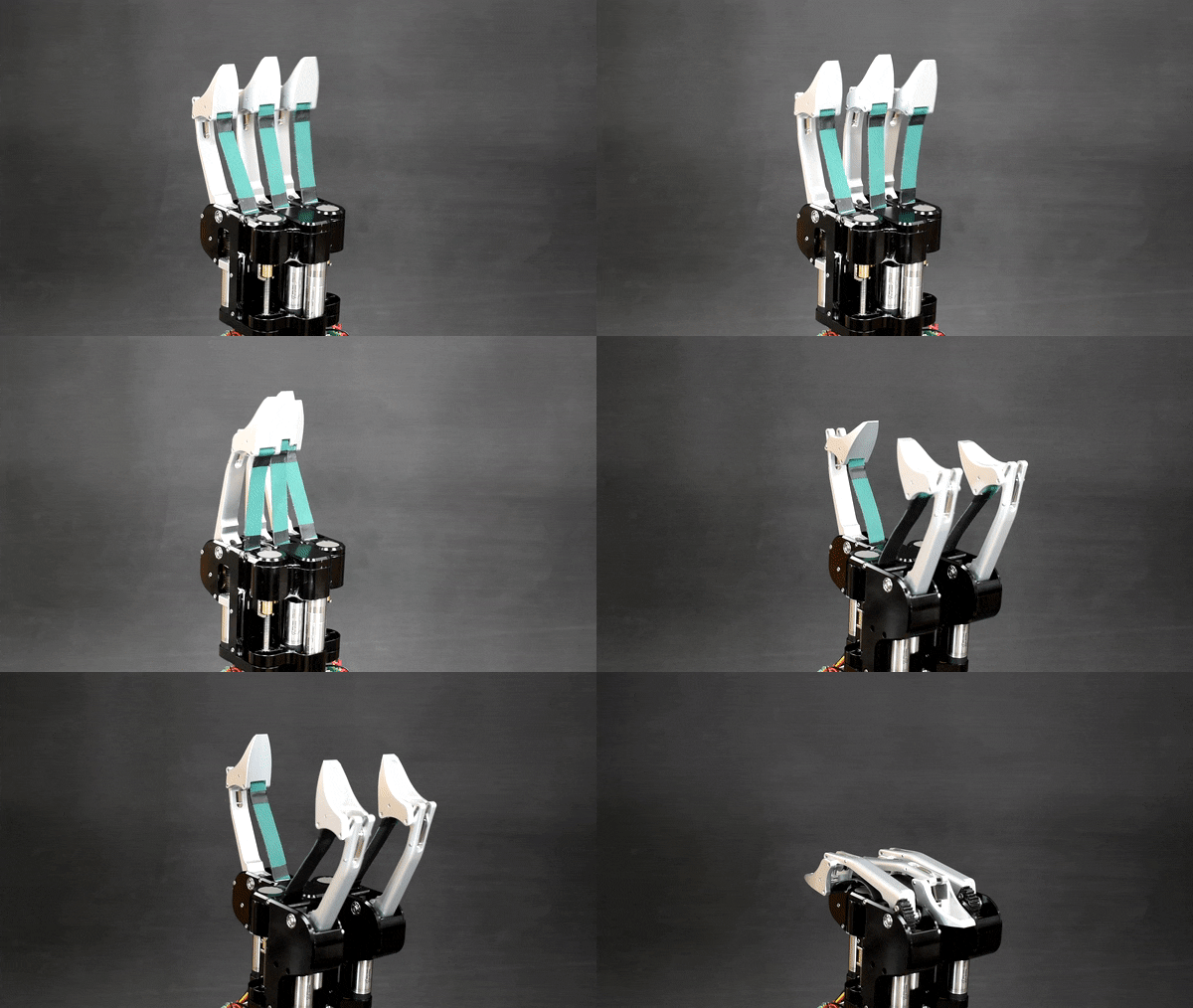
BLT Gripper (Belt and Link actuated Transformable Adaptive Gripper), 2020
With regard to this, there is a robotic hand that is drawing particular attention. It is the “BLT Gripper,” researched by one of the world's leading robotics engineers Professor Yong-jae Kim of KOREATECH. It is a new type of robotic hand with a simple structure, capable of conducting precise work. Professor Yong-jae Kim has been working with NAVER LABS since 2016 as part of academia-industry cooperation to research and develop robots that are as flexible and safe as humans, including the robotic arm of AMBIDEX. We sought to hear a story about the development of robotic hands from Professor Yong-jae Kim.
Q. What is the significance of studying robotic hands?
Human hands are very interesting subjects for robotics engineers. They do extraordinary things. They can grab a slim ballpoint pen with precision and change the grasping method in various ways. They can also easily retrieve a cell phone from your pocket, write a message with one hand, shift the position of grasp, and hand it over to you. From an engineer’s perspective, flexibility, sensitive sensors and sensor feedback as well as gravity and moment-based control all happen in an instant. That is to say, it is the human hand that possess extremely optimized mechanism, sensors and control algorithm.
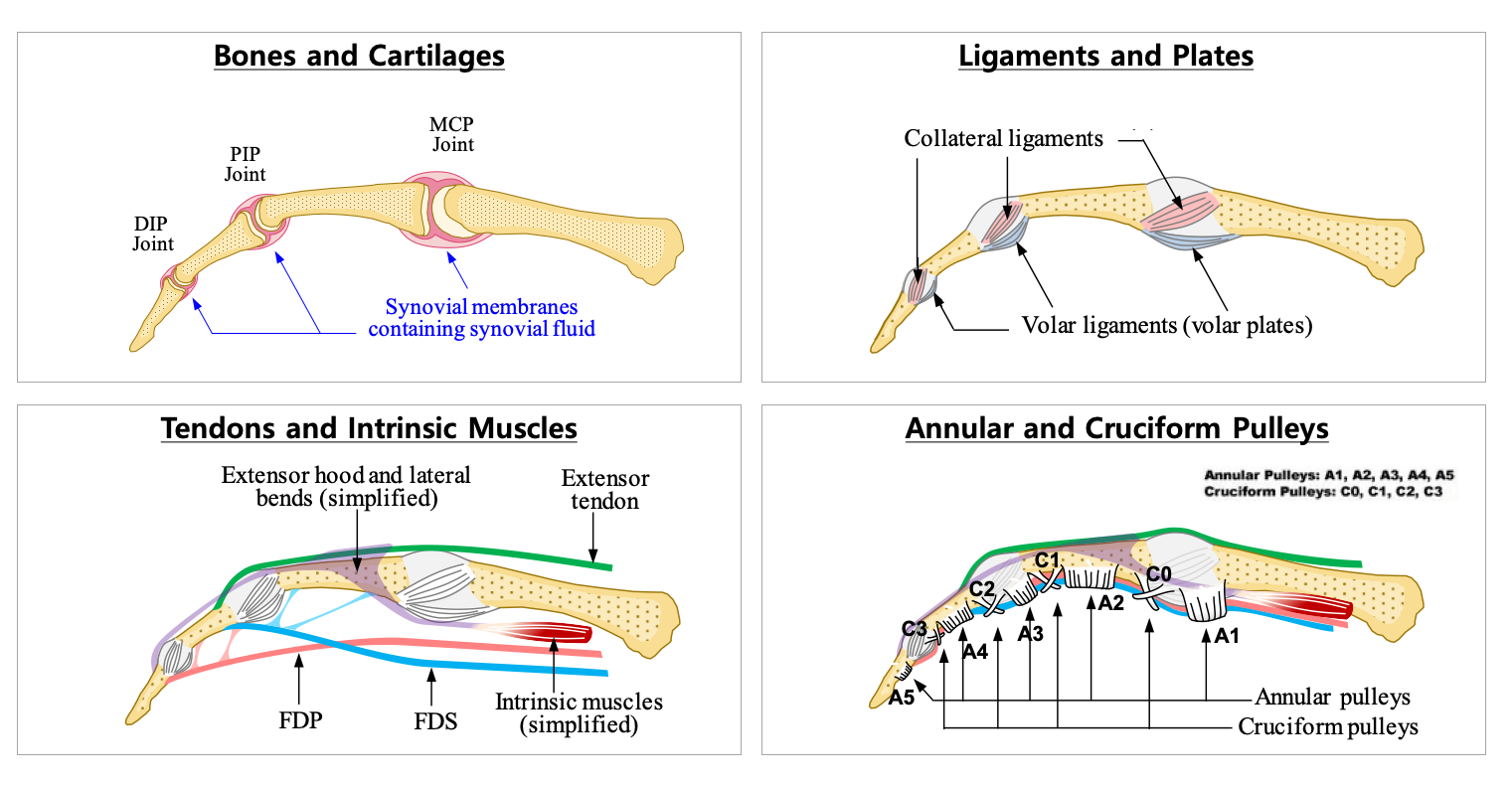
Joints, tendons, and muscle structure of the human hand [1]
Robots have a lot to learn from the human hand—not only its shape, but also its material, lubricating method, driving method, and so on. For example, the human hand operates under the driving principle of reducing friction with synovial fluid that has 50 times less friction than the lubricant used by robots, while a great many tissues move in contact with each other. These structures inspire robotics research to pioneer new fields.
Perhaps, the hand is the field that best suits the purpose of robotics development. The actuator is essential for the robot to move and operate, and the very contact of motion that gives rise to changes in the surrounding environment is the hand. Since 2008, I have been studying and developing more simple and practically-structured grippers, including robotic hands with a high degree of freedom that are similar to human hands in shape. Not only their functions, but also their size, weight and durability serve as important criteria. This is because the robotic hands are not used on their own, but eventually attached to robotic arms.
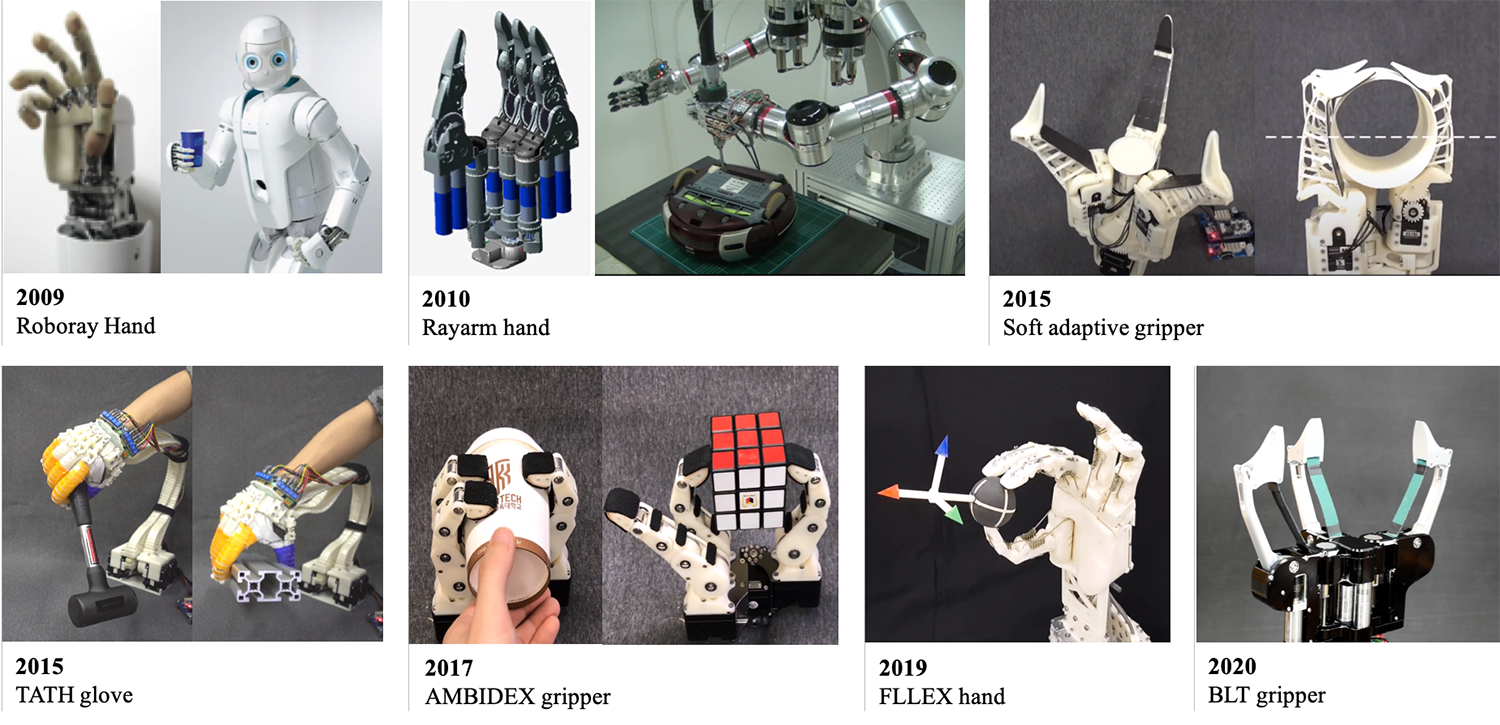
Robotic hands and grippers of continued research and development
Q. What are some characteristics of the recently announced BLT Gripper robotic hand?
BLT Gripper has a very simple structure. However, it can handle various objects like a human hand. I have made many attempts to implement efficient functions with a simpler structure and a degree of freedom, and these efforts have been crowned with the robotic hand.
The human hand is made up of 27 individual bones and over 30 muscles connected to each other, with as many as 23 degrees of freedom. It is still difficult for robots to catch up. In most work sites that utilize actual robots, robot grippers with 1 to 3 degrees of freedom are replaced and used according to need. Two parallel fingertips of an industrial gripper are used to hold a standardized object correctly or to tie it with a strap or belt to hold it firmly and flexibly. However, what is interesting is that the way a human hand holds objects is actually similar to this.
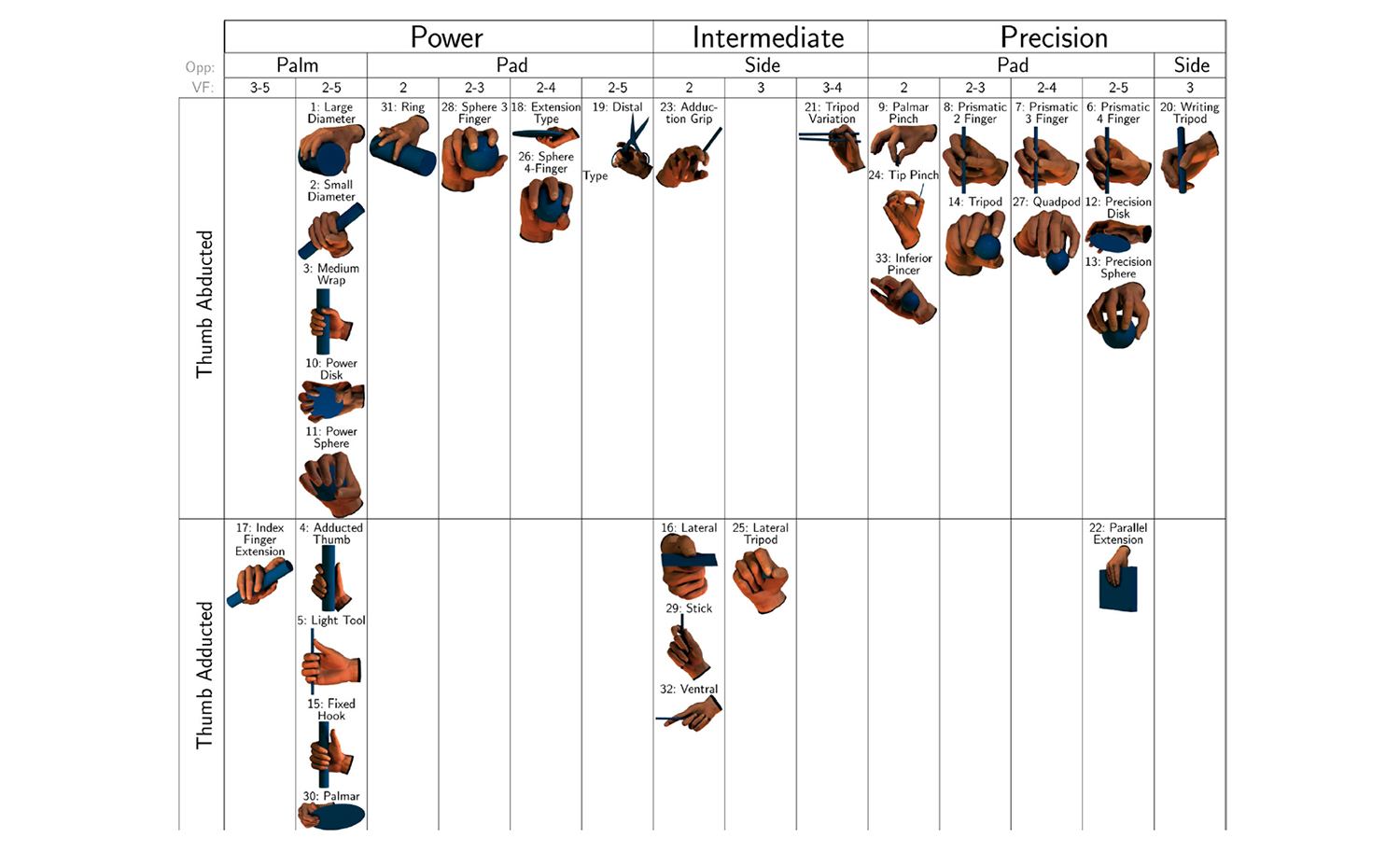
Biomechanics can be broadly classified by precision pinching and power grasping. [1]
A function that is difficult to implement in practice is shifting from precision pinching position to power grasping position, or vice versa, in a highly natural manner. The biggest feature of BLT Gripper is that it is capable of both precision pinching and power grasping with just one robotic hand. It moves precise and powerful fingertips that face each other in parallel to pose “precision pinching” like an industrial gripper, and the belt part of its fingers can wrap around objects in various shapes, allowing it to take a flexible but powerful “grasping position.”
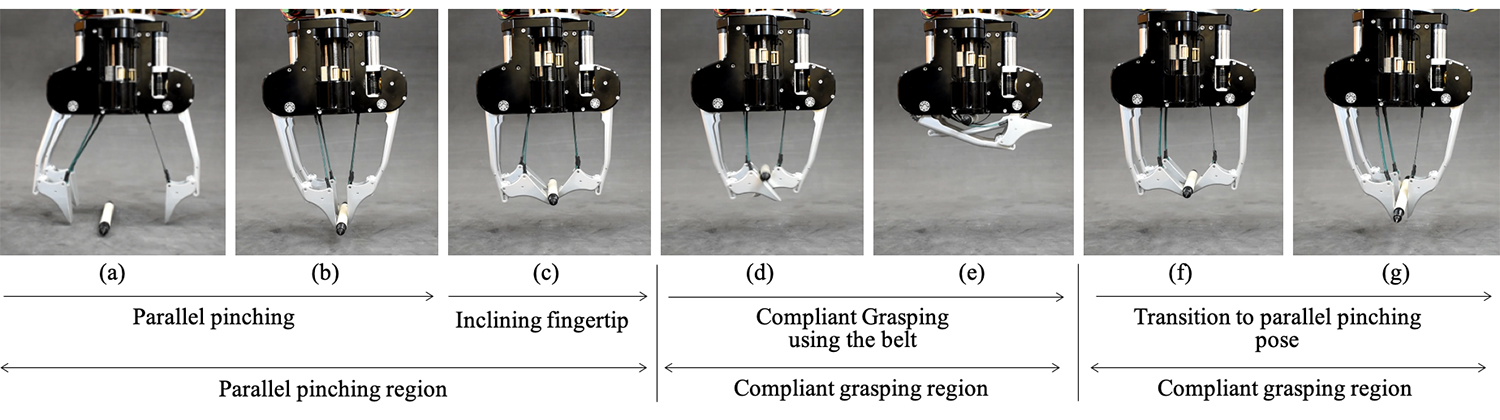
Experiment on transition from precision pinching and grasping
Although the grippers, which carry out both precision pinching and power grasping with one hand, have been previously developed in several ways, BLT Gripper is the only robotic hand that has the capacity to change the method of grasping by itself. This idea started with a much more complex structure at first, but after many trials and errors, we were able to deduct both performance and simple mechanism at the same time.
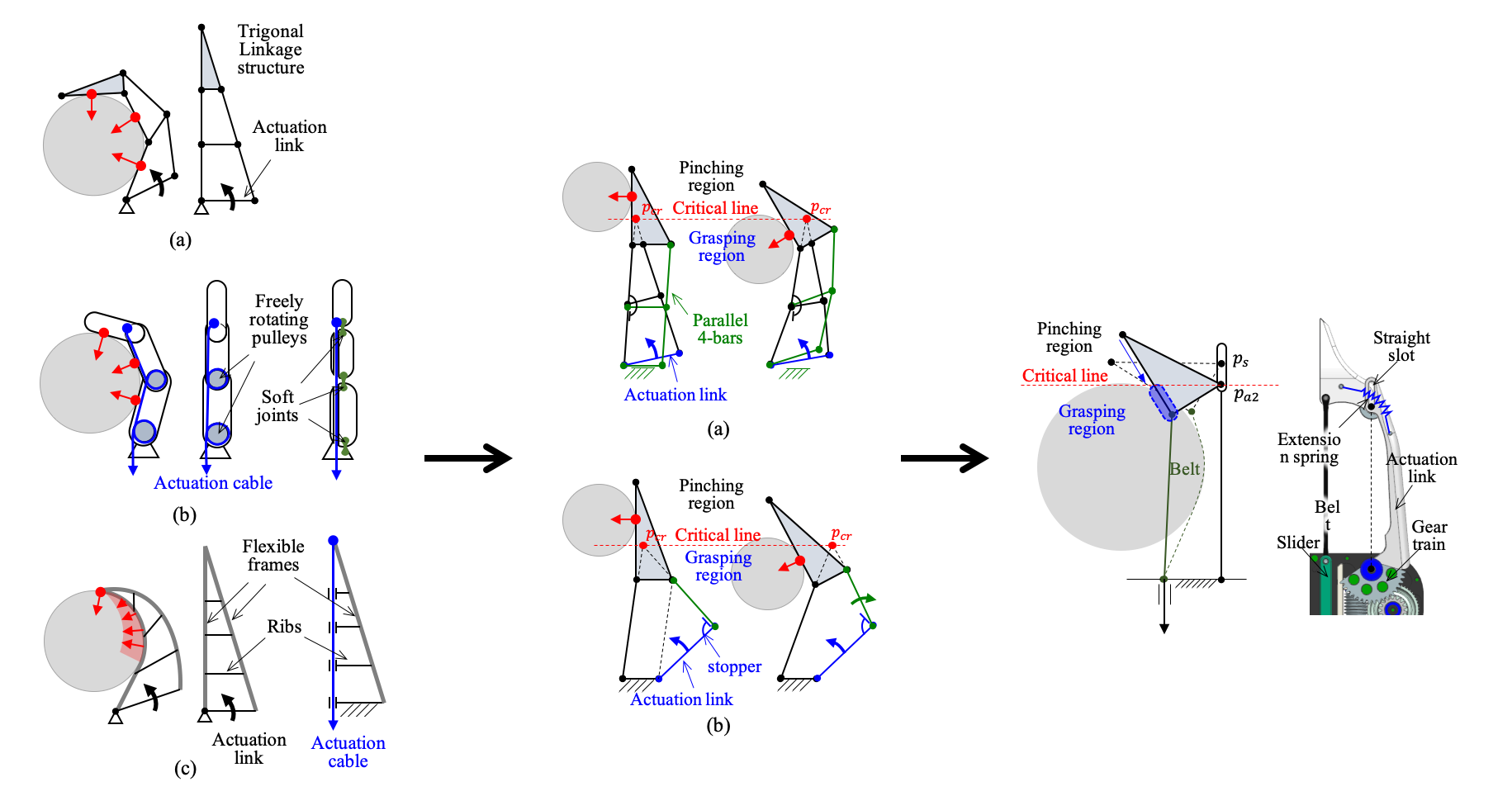
Deductions of BLT Gripper’s mechanism
Q. Please give us a more detailed description on BLT Gripper’s structure.
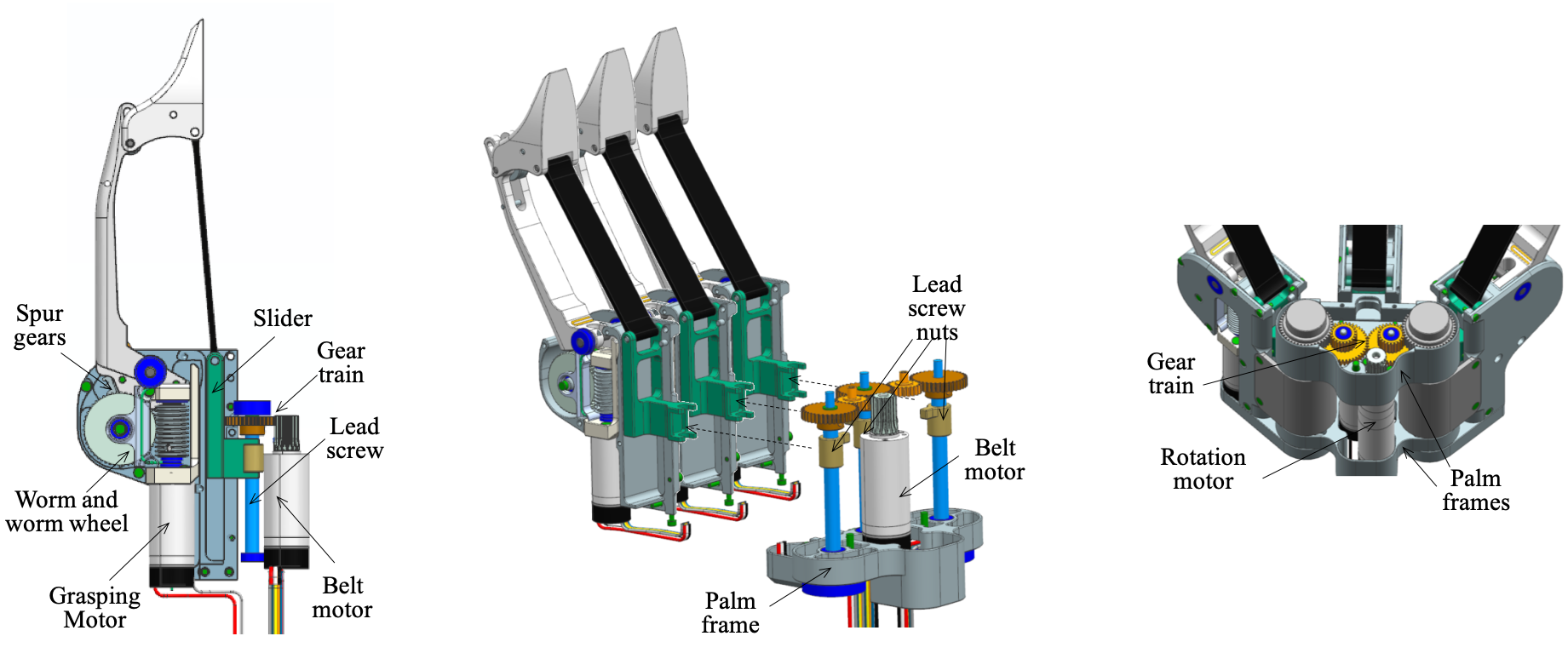
Diagram of BLT Gripper’s motors
BLT Gripper is made of three fingers and five motors with 5 degrees of freedom. Three of these motors play the role of bending three fingers. Another motor serves to change the angle of the three fingertips at once. The remaining motor rotates the fingers on both sides to enable picking up with two fingers and three fingers, grabbing cylindrical objects, and so on. Grasping after repositioning the fingertips to an appropriate angle, draws the object inward to conduct a power grasping in an automatic and flexible manner. The combination of belt and slot implements the under-actuated mechanism that displays the ability to hold an object according to its shape, without any complex control with a high degree of freedom.
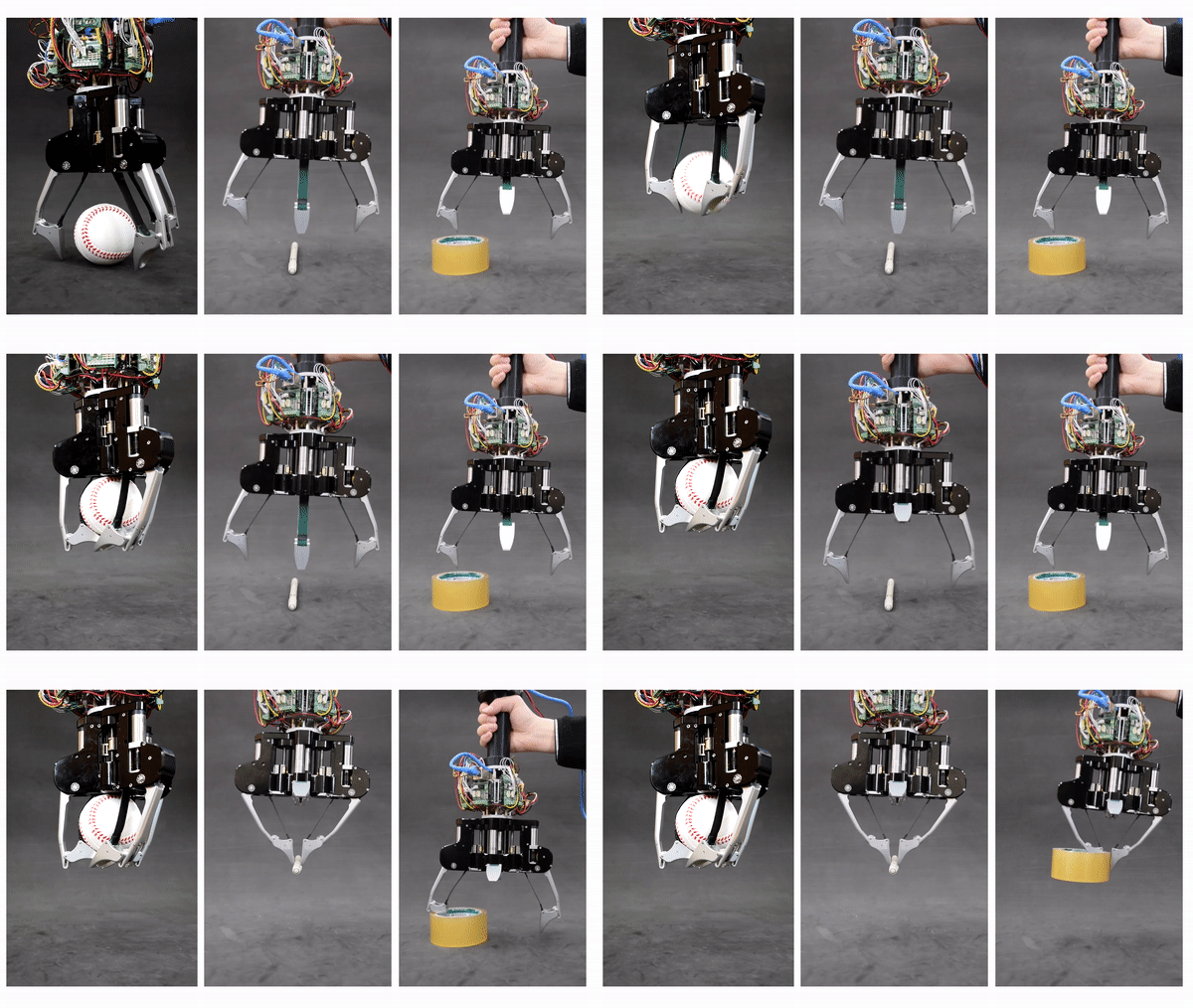
BLT Gripper's grasping method for objects of various sizes and shapes
“‘BLT Gripper’ stands for ‘Belt and Link Actuated Transformable Adaptive Gripper.’ In fact, BLT is more famous for the sandwich made of bacon, lettuce and tomato. It portrays the expectation that anyone will be able to easily make good use of BLT Gripper, and a perfect combination of very simple components of belt and link can achieve high performance.”
Q. Are there any other tasks you are currently working on?
In addition to BLT Gripper, we are also developing FLLEX hand with a more complex structure that displays 15 degrees of freedom. Our goal is to achieve durability, precision, and great strength like human hands without relying on conventional bearings or metal parts.
Perhaps in the future, the robotic hand will not experience too much rise in weight, complexity, and control difficulty as its degree of freedom increases, and it will not have to sacrifice its flexibility to increase precision. We are constantly debating what kind of research is required to bring forward this era.
"A human hand is more precise than a luxury watch, but it is strong enough to not break when sat on and to withstand human weight by hanging with just one hand. No robotic hand made of strong metal displays this level of performance. However, in the future, robotic hands will gradually evolve towards the direction of being light and flexible while displaying high performance just like human hands.”
Q. How will robots that interact with humans naturally and safely evolve in the future?
Collaborative robots with the ability to safely interact with humans will be able to work with workers without safety fences, unlike conventional industrial robots. However, many robots still remain heavy, inflexible and vulnerable to impact. Although academic circles are rapidly improving the performance of robots using machine-learning and data-based algorithms, these efforts are limited to adding a force-control feature to existing industrial robotic arms. For safer, more agile robots, we need innovative robot mechanisms that are extremely light like human arms and capable of absorbing impact like human hands. It is also important to reconsider whether motors, bearings, rotating joints and metal frames that have been conventionally used in robots are indeed the best choices.
"Human-robot interaction will also see a paradigm shift. People naturally cross their arms, tap the back of the person in front of them to draw his/her attention, and work comfortably leaning on the desk with their elbows. Robots need to be able to do these things, too.”
The interaction algorithms that have been applied to most robotic arms have adopted the means of either avoiding collisions with humans in the first place or between robotic arms. I believe that the concept transformation in the hardware and control algorithms will create new opportunities for human-robot interaction. From now on, robots will increasingly be able to move beyond fences to restaurants, homes, offices and our daily lives.
Q. Do you have anything to say to robotics researchers or students?
I hope they will always remember that robotics is a very exciting field. Perhaps, many people have started to study robotics as they were captivated by the joy of making things move and the thrill of bringing machines to life. Robotics researchers from around the world drawn by this allure have opened up new fields such as surgical robots, cleaning robots, cooperative robots, unmanned vehicles and drones.
By all means, research that take into account profits and markets are also highly important and meaningful. However, what is more special about the field of robotics is that it gives you the freedom to explore uncharted territories. I hope that people will keep this in mind and use at least part of their passion for research to realize their own dreams.
The field of robotics is very broad. If you try to get a taste of it in its entirety, you will feel the limitation of your capabilities at some point. It has also happened to me a lot of times. However, do not be discouraged at times like this. You will realize that organizing a good team with great colleagues from various fields and propelling further together with each other is the most rewarding and pleasant way. I hope to go on a great expedition one day with many robotics researchers and the students who wish to join them when the opportunity arises.
Reference
[1] Y.-J. Kim, et al., "Fluid Lubricated Dexterous Finger Mechanism for Human-Like Impact Absorbing Capability," IEEE Robotics and Automation Letters, Vol. 4, No. 4, pp. 3971-3978, Oct. 2019.
[2] 인간 손의 다양한 파지 분류. T. Feix, et al., “The grasp taxonomy of human grasp types,” IEEE Trans. on Human–Machine Systems, Vol. 46, No. 1, pp. 66–77. 2016.