A robot is delivering coffee. It makes its way over to the pick-up zone, sends a notification to the recipient, opens the cargo box when it arrives in front of them and returns.
The robot knows how to open its cargo box, but it doesn’t know when to do so. It also doesn’t know when to send notifications, nor what to do if the user doesn’t show up after a certain period of time. The rules and decisions which determine how the robot should operate are defined in the ‘service logic’.
Traditionally, developers had to manually implement this logic through code. In fact the entire process starting from retrieving orders, checking conditions, moving the robots to a specific location and right up to updating the arrival status, was written entirely in code.
FLOW changes this approach. Actions like “Order received”, “Robot on the move”, and “Delivery confirmed” are arranged in the form of cards, and these cards are connected to each other based on conditions to create a ‘service flow’. A single card is an execution unit linked to a specific function, such as moving the robots, opening/closing the cargo box, changing status or sending notifications. Even if you don’t know how to code, you can see how the robot works just by reading the cards, and if you want to change the flow, all you need to do is add a card or modify the conditions.
FLOW is changing service authoring methods by enabling anyone to read, modify and extend service logic.
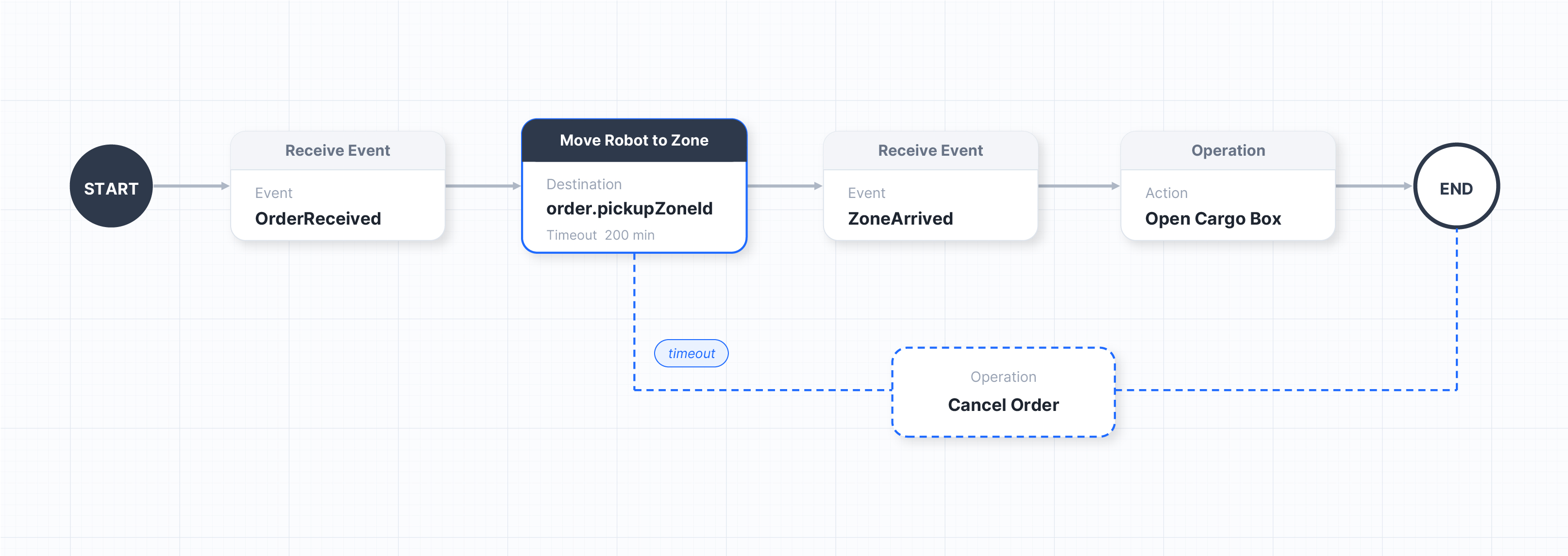
Example of the FLOW logic screen
Making it easier and faster to build robot services with ARC brain
The greatest value of FLOW is that it makes building ARC brain-based robot services faster, easier to modify and simple to expand them to larger spaces.
Café services, package deliveries and peer-to-peer deliveries all have different flows. The way orders are received, where the robots need to go and how users load and unload items are all different. FLOW defines these variations not through code, but through flows. Even when the space changes, you don’t have to change the whole system from scratch; you simply need to adjust the cards to fit the new conditions. Based on the existing flow, you can conveniently adjust only what has changed, such as the ordering system, method of collection, access policy and notification timing.
The adjustment facility of FLOW is especially important when ARC brain expands to external regions. The peer-to-peer delivery and robot service operations experience verified in 1784 serves as the starting point for FLOW-based service logic. In Saudi Arabia, the business logic for robot services in a smart building was implemented based on FLOW and connected to ARC brain. Similarly, Japan’s Yaesu robot building project is moving forward with the transition to and application of the FLOW-based structure.
Ultimately, FLOW is more than just an internal tool for development convenience. It’s a core technology designed to accelerate service deployment and localization when providing ARC brain as an external solution. By enabling building managers, local operators and third-party partners to grasp the service flow and make modifications, FLOW eliminates the need to understand the entire code base.
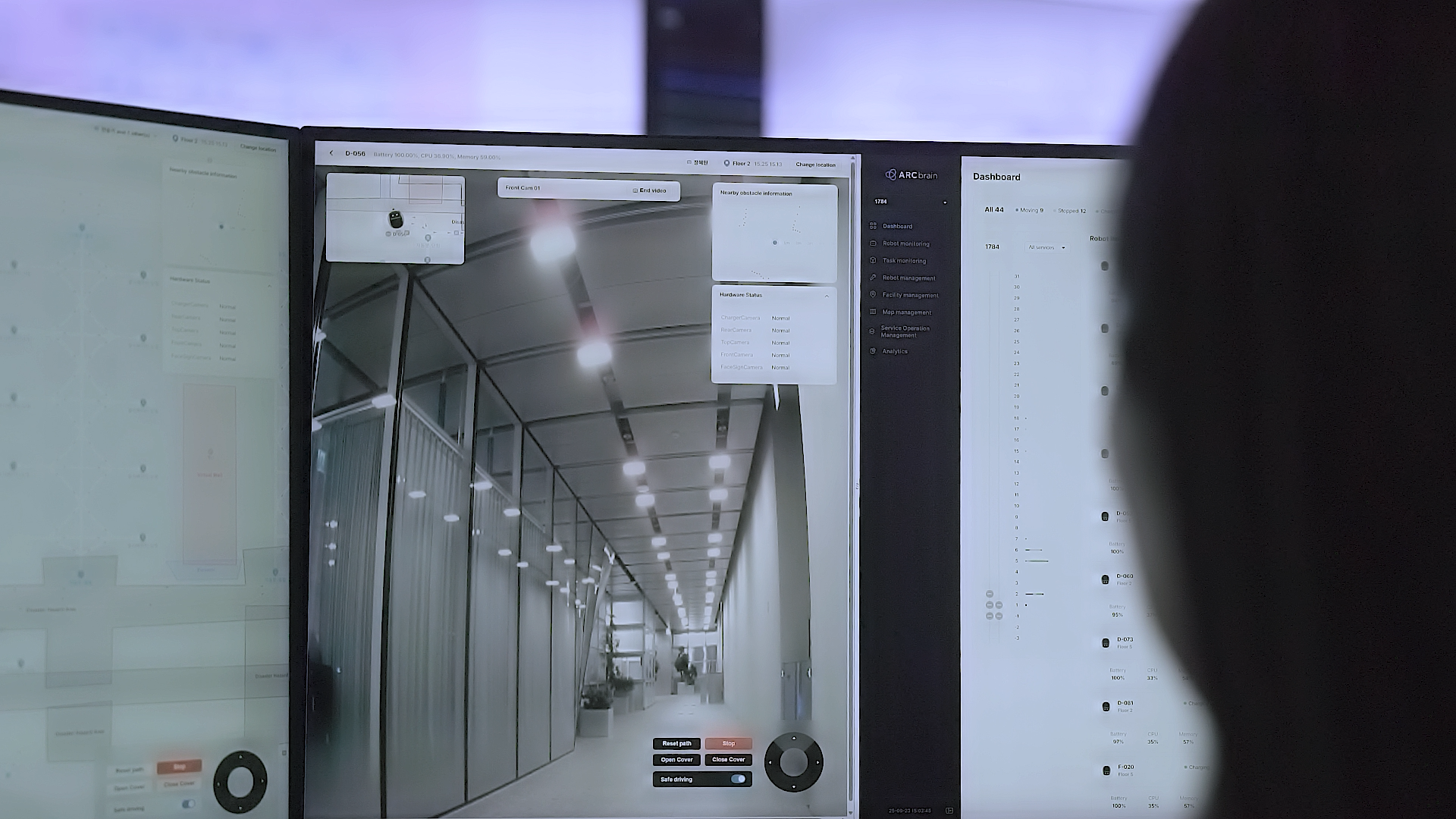
FLOW in the era of AI agents
The next step for FLOW is integrating natural language. At the moment people manually arrange the cards and connect them based on conditions, but in the future, natural language-based AI agents will take over this process.
A simple natural language request, such as “When a café order is received, send the robot to the pick-up zone and send a notification to the user upon arrival,” is all it takes to automatically generate a draft of the service flow. Administrators can then review the generated flow and easily adjust it. Expert knowledge is no longer required to author robot service logic.
This application of AI is used not only to create new flows, but also to inspect and improve service logic already in operation. When an issue arises in a live FLOW system, administrators can leverage the AI agent to quickly pinpoint where the problem has occurred and identify the conditions that need adjustment for an easy fix.
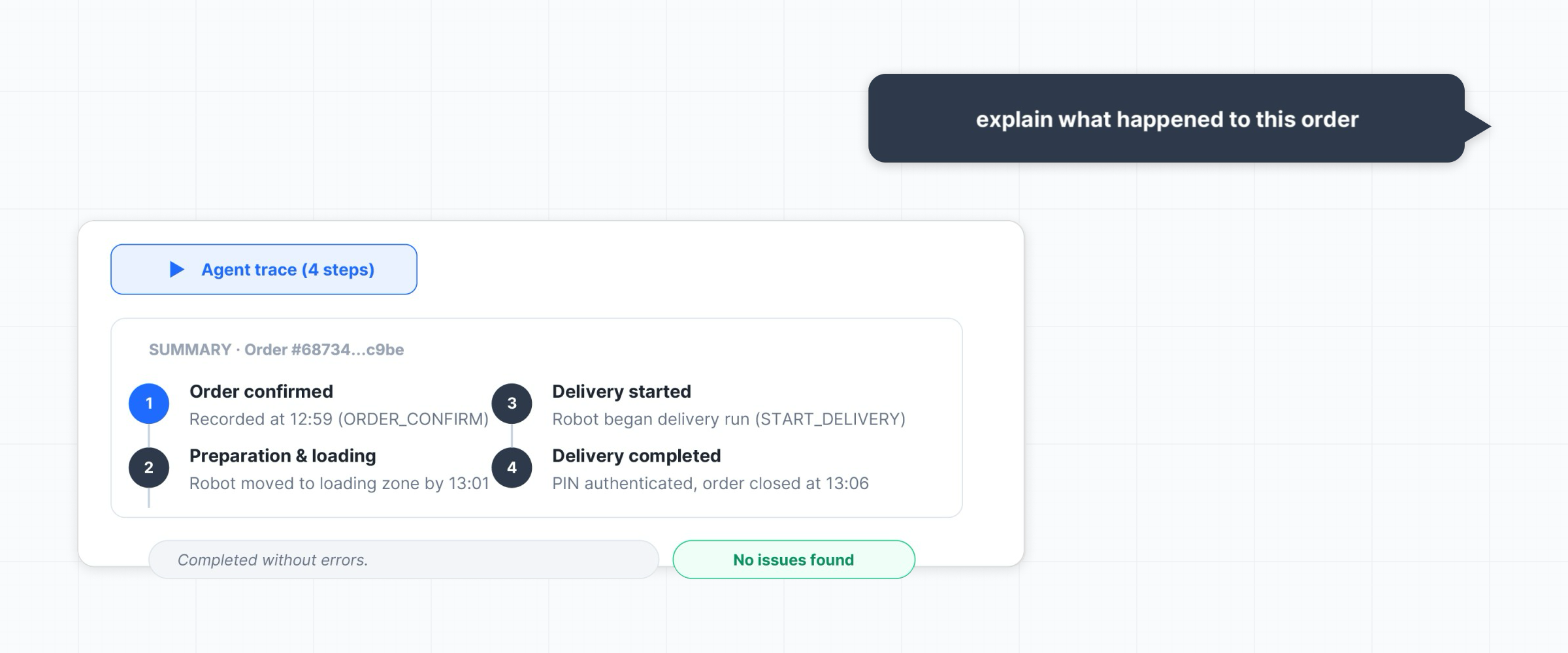
An example screen of FLOW authoring using natural language
The crucial point here is not that AI nor AI agents replace everything. Robot services are executed in real world physical spaces so we need a structure that humans can easily understand, verify and control. Furthermore, in an era where AI agents autonomously operate robot services, FLOW becomes an essential intermediary.
The flow of how the AI agent makes decisions and determines the order of robot operations must be visualized in a way that’s easy for humans to understand. Text-only logic makes it difficult to locate errors and verify what is actually being executed. FLOW provides a reliable visual framework to easily verify the AI agent decisions and debug any issues when they arise.
Powered by FLOW
For robots to operate in a wider variety of spaces, services must be easy to create and modify. Furthermore, the more autonomous these services become through the use of AI agents, the more essential it is to have a structure that humans can understand and easily use to control the flow.
FLOW was designed for precisely such a transition. By shifting robot service authoring from code to flows and expanding it to incorporate natural language and AI agents, FLOW is transforming the way robot services are built.