Recently, it has become much more common to encounter delivery robots inside buildings. For these robots, riding elevators is essential for moving between floors. However, this process can sometimes cause inconvenience to people or interfere with passengers entering and exiting the elevator.
If it were a human, that person would naturally assess the situation and make a judgment.
“It’s pretty crowded right now. I should wait for the next elevator.”
“There’s probably room for one more person.”
But how should a robot make that decision? And how will people perceive and respond to the robot’s judgment? We presented our research addressing these questions at the ACM CHI 2026.
What Previous Research Has Overlooked
Research on robots using elevators has been conducted for quite some time. Representative topics include determining a robot’s location inside the elevator and planning its boarding path. However, these studies generally assume that the robot will board the elevator.
Yet there is a more fundamental question.
Should the robot even attempt to board in the first place?
If a robot insists on boarding regardless of the situation, passengers may feel uncomfortable. On the other hand, if the robot is overly cautious and frequently gives up boarding, deliveries may be delayed. Faced with this dilemma, our research aimed to model a robot’s boarding decision from a human-centered perspective.
When Do People Allow Robots to Board an Elevator?
The first study was conducted as an online survey. Participants who were familiar with delivery robots were presented with a variety of scenarios and asked to judge whether it was appropriate for the robot to board the elevator.
.jpg)
In this study, we defined a concept called the “Robot Boarding Area (RBA)” for modeling purposes. The RBA refers to the minimum amount of space that allows a robot to enter the elevator on its own, without requiring passengers to deliberately move aside. In most cases, this corresponds to the area near the center of the elevator doorway. Since people typically occupy spaces along the walls and corners first, the central area in front of the door tends to remain available until relatively late.
The scenarios were constructed by combining two factors:
• The total number of passengers in the elevator
• Whether a Robot Boarding Area (RBA) was available
As the total number of passengers increased, people tended to be less accepting of a robot boarding the elevator. Even with the same number of passengers, acceptance was lower when the RBA was occupied by other passengers. Conversely, even when the RBA remained unoccupied and the robot could physically enter the elevator, people were less accepting toward the robot boarding as the overall occupancy of the elevator increased.
This shows that whether a robot should board is not simply a matter of whether there is enough space. The results suggest that people make their judgments by also considering the broader social context, including other passengers’ personal space and psychological comfort.
In a Crowded Elevator, Should the Robot Board or Wait?
The second study was conducted using a VR experiment to provide participants with an experience that closely resembled a real-world situation. The number of passengers inside the elevator was set to 5, 7, or 9 people, and participants directly experienced situations in which the robot either attempted to board despite limited space or gave up boarding.
.jpg)
The key insights from this study are as follows.
When it’s crowded, it’s better to wait.
In crowded situations, participants viewed it much more positively when the robot quickly gave up boarding and waited for the next opportunity, rather than insisting on boarding.
"If the elevator is crowded, it's better for the robot not to get on."
"It was uncomfortable when the robot tried to squeeze in even though the elevator was already full."
Inconsistent behavior undermines trust.
When the robot made different decisions in situations that appeared similar, people felt confused and rated the robot as less trustworthy.
"The situations seemed similar, but sometimes the robot boarded and other times it didn't."
"When the robot chose not to board even though there was space available, it felt inefficient."
Voice announcements improve understanding and acceptance.
When the robot verbally explained its intentions, the participants' understanding and acceptance increased.
"When the robot spoke, I immediately understood what it was trying to do."
"Once it said it was making a delivery, its boarding made more sense to me."
Delays in decision-making make people feel like they are waiting longer.
The longer the robot hesitated over whether to board, the more participants felt that they were being kept waiting. In other words, the perceived waiting time increased, even when the actual time did not. This highlights the importance of making decisions quickly.
"It felt like the robot was trying to decide whether to get on or not, and we were the ones waiting for it."
"Because the robot kept explaining its status, it felt like the boarding decision took longer."
Three Guidelines for Robots in Elevators
Based on the findings of our study, we propose the following design guidelines.
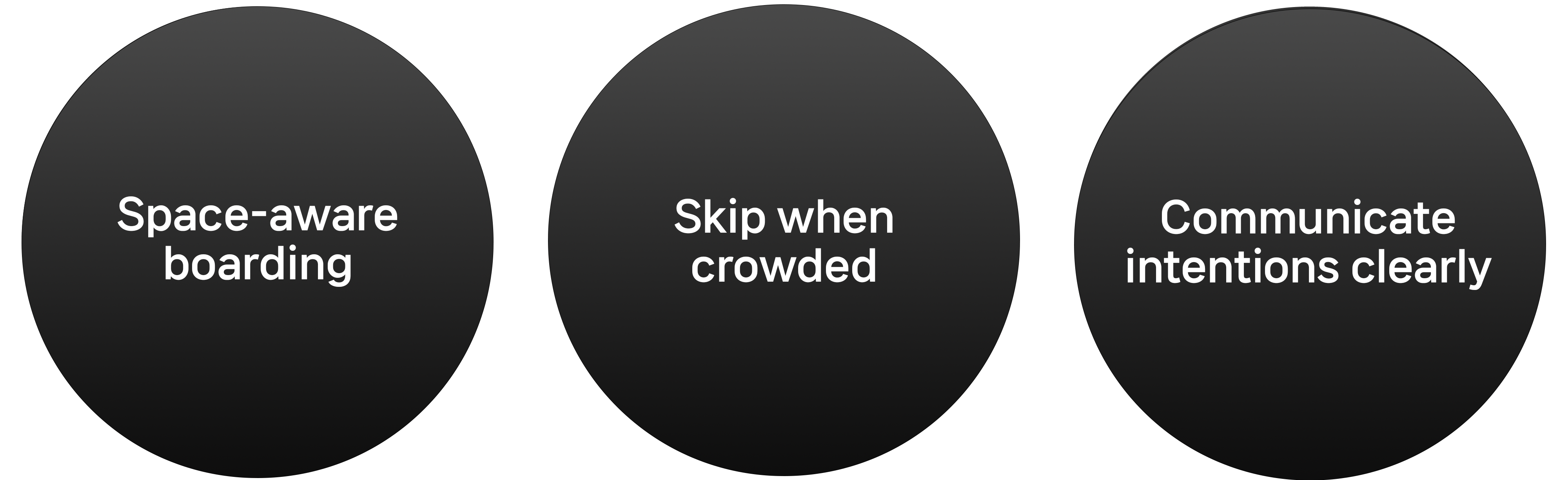
Space-aware boarding: Beyond simply determining whether physical entry is possible, both the availability of boarding space near the elevator entrance and the overall level of crowding should be taken into account.
Skip when crowded: In crowded situations, quickly giving up on boarding can actually improve the user experience and help maintain a smoother overall flow.
Communicate intentions clearly: Robot behavior should be predictable. Intentions should be communicated clearly through brief messages and voice announcements.
A robot boarding an elevator is not simply a matter of mobility. It involves complex social judgments.
For more details > “Too Crowded for a Robot?”: Modeling Human Acceptance Criteria for Elevator-Riding Robots