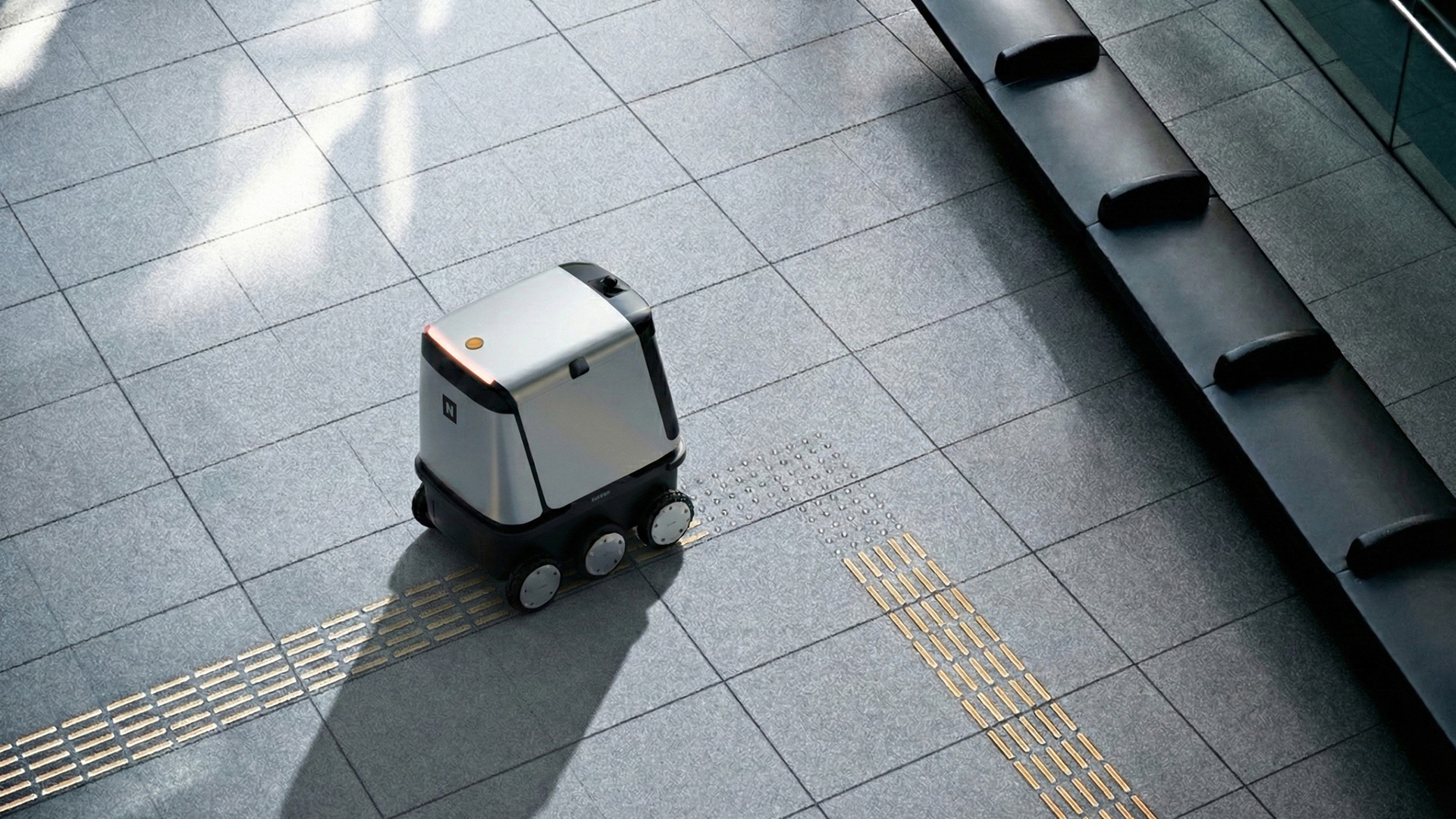
This content has been reconstructed based on an interview with Jong-yoon Baek, Group Leader of Robotics & Autonomous Driving at NAVER LABS, featured on KBS N’s AI-topia, as well as an article from the NAVER Cloud Tech Blog. It centers on ARC, NAVER LABS’ core technology.
Robots Moving Beyond Factories and Closer to Everyday Life
Robots are rapidly expanding beyond industrial sites into the service sector. Service robots that perform specific roles, such as autonomous taxis, serving robots, and home cleaning robots, are already becoming part of everyday life.
NAVER’s robot-friendly office building, 1784, stands at the forefront of this transformation. At 1784, more than 100 autonomous robots move throughout the building each day, carrying out delivery services. It is a real-world environment where humans and robots naturally coexist within the same space. Building on this, research is actively underway to further enhance robots’ ability to respond independently to various situations using AI, as well as to enable direct interaction with people and objects, like picking up or delivering items. Operational experience and the space, sensor, and service data accumulated in a real-world testbed environment play a critical role in this progress. 1784 is more than just an office building; it is regarded as a smart building testbed and a global reference point, where large-scale robot operations and rapid integration of new technologies are possible.
These experiences have also clearly shown what is required for service robots to operate effectively in real-world environments. As robots expand into everyday spaces, challenges emerge that cannot be solved by the performance of individual robots alone, and the ability to efficiently manage large numbers of robots and rapidly scale diverse services has become a key factor in the widespread adoption of service robots.
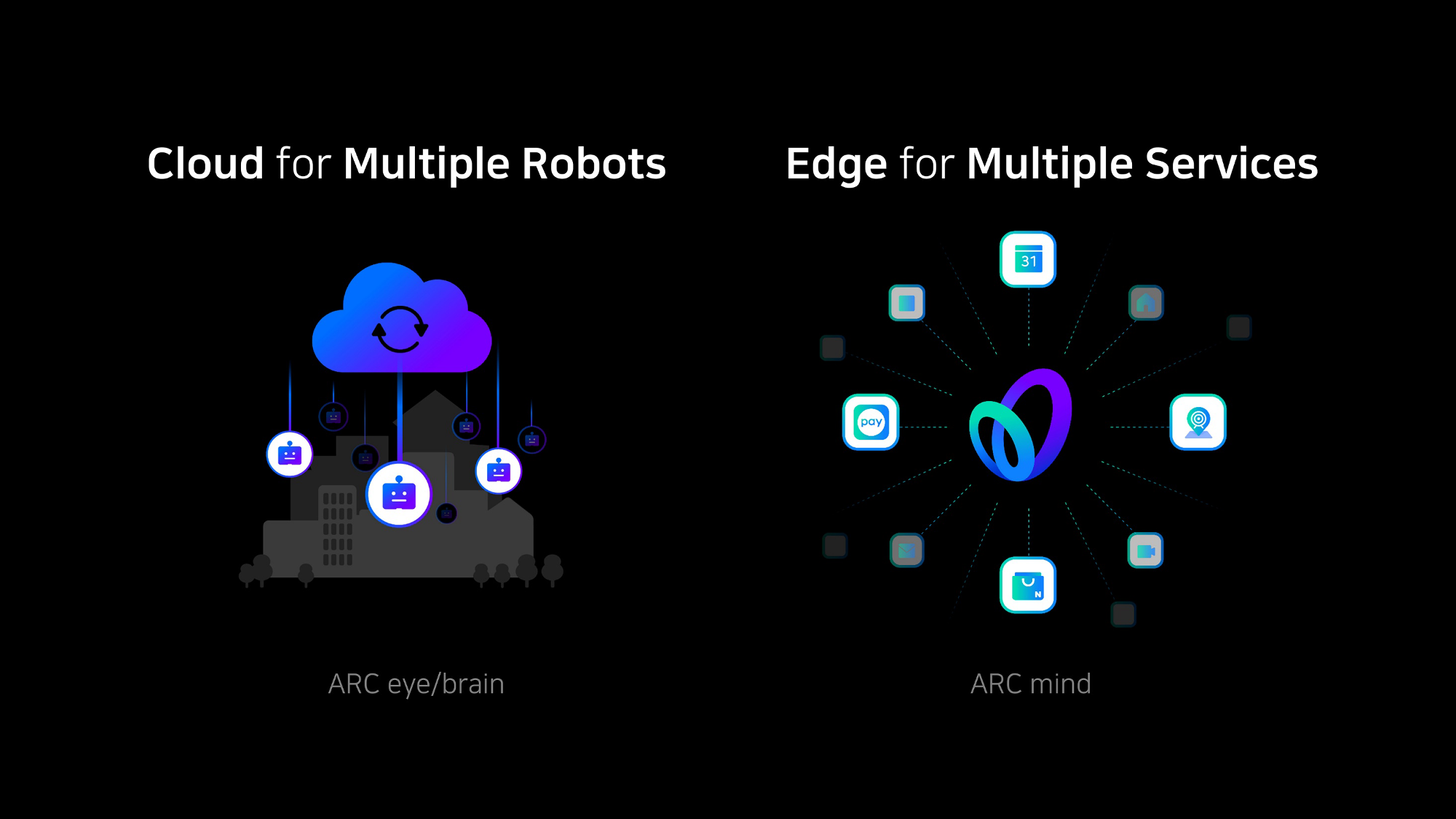
ARC Platform Connecting Countless Robots Through the Cloud and Expanding Services Directly on the Robot
Core Technology Driving the Widespread Adoption of Service Robots
① Intelligence that Connects Numerous Robots into One
What is required for robots to operate in cities and large-scale environments? It is not simply “smarter robots.” Beyond improving the performance of individual robots, a system is needed that can efficiently operate various types of robots within a single space. At the building level and further at the city level, numerous robots must move simultaneously while performing a wide range of tasks. Therefore, controlling each robot individually has clear limitations. A central intelligence that can comprehensively manage the movements and tasks of all robots and coordinate their priorities is essential.
To implement such a structure, NAVER has developed ARC, a multi-robot intelligence system. ARC connects different types of robots through a single cloud-based intelligence, coordinating their tasks and movements in real time to maximize service efficiency. At the robot-friendly office building 1784, robots utilize digital twin–based spatial data through ARC to identify their locations and continuously update optimal routes and tasks for service execution. In addition, by integrating with building infrastructure, such as Roboport systems and door controls, robots are helped to move freely throughout the entire building.
This cloud-based architecture reduces the computational burden on individual robots while simultaneously improving operational efficiency and cost competitiveness. As the number of robots increases, the importance of intelligence that connects and orchestrates the whole system becomes even greater.
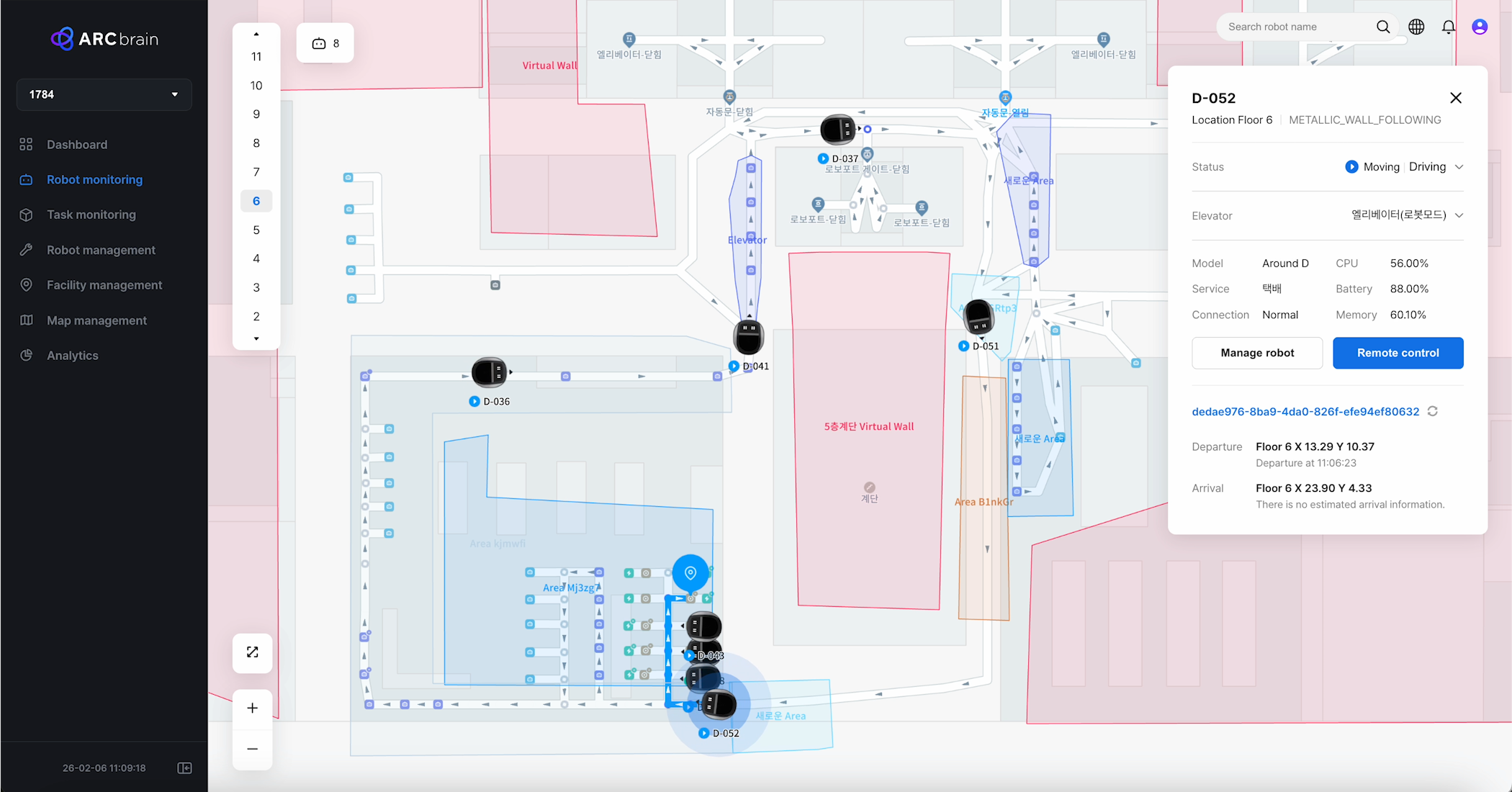
Multi-Robot Control in the NAVER 1784 Building Through ARC brain
② An OS that Opens the Robot Service Ecosystem
For the service robot industry to grow, an environment must also be in place where diverse services can be developed quickly. Although the service robot market is expanding rapidly, the service ecosystem itself remains in its early stages. The reason is clear: robot technology and the service development environment are separated from one another. Robot developers focus on hardware and autonomous driving technologies, while service developers lack experience with robot platforms. This gap has long been the greatest barrier to rapidly creating new services.
To bridge this gap, the robot service development environment itself needs to be redesigned. In this context, ARC mind has emerged as a robot operating system. ARC mind is a web platform–based robot OS that enables service developers to implement various services, such as ordering, payments, and content integration, through robot-specific web APIs, without requiring deep knowledge of robot hardware. Through this approach, a single service can be commonly applied across multiple types of robots, and the combination of robots and services can be flexibly expanded. Just as operating systems in the smartphone era drove the growth of service ecosystems, this structure serves as a core foundation for accelerating the expansion of the robot service ecosystem. As more developers are able to participate in robot service development, robots evolve beyond machines that perform specific functions into platforms where a wide variety of services are connected.
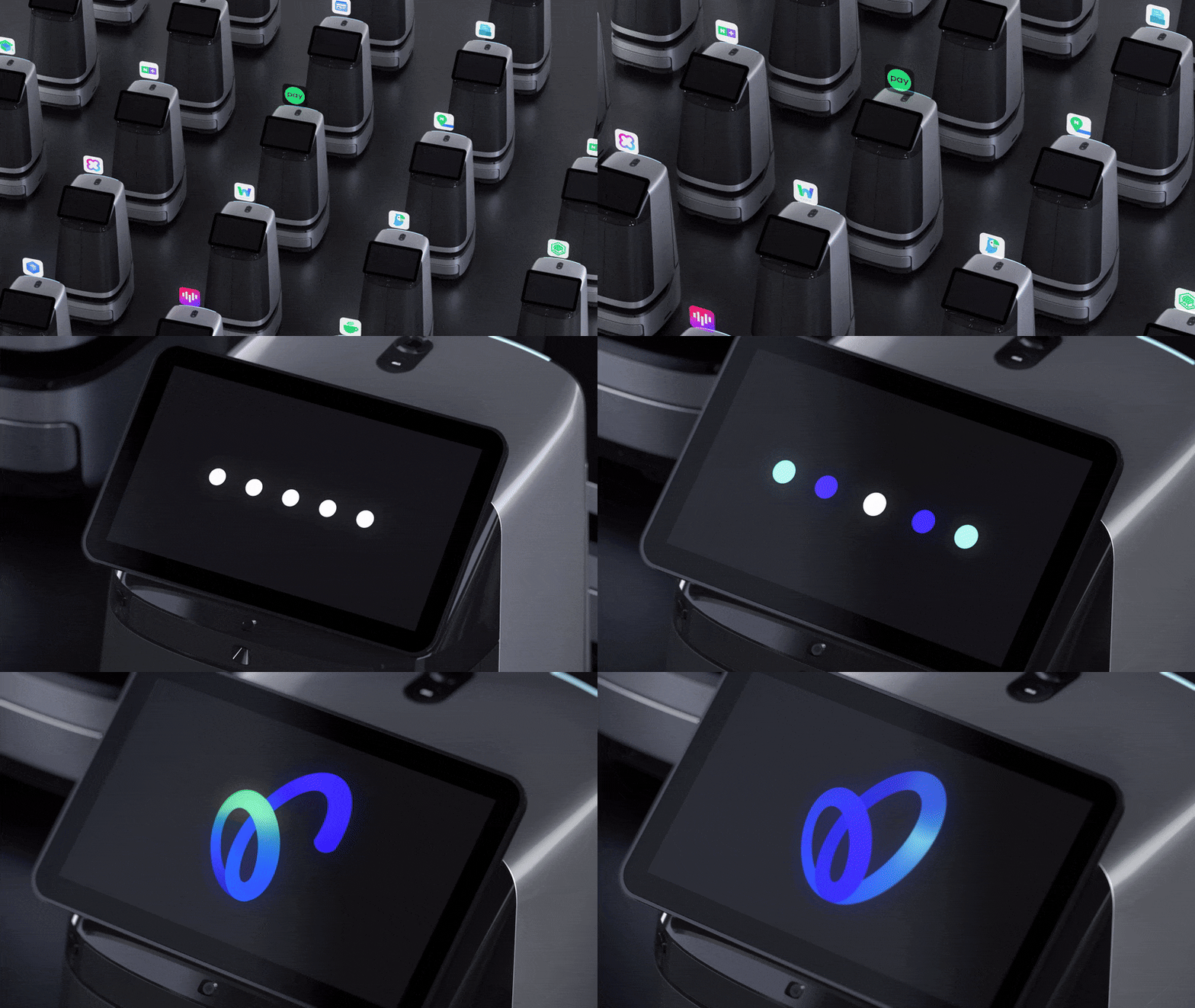
ARC mind: A Web Platform–Based Robot OS
A Future Where NAVER Becomes the Platform for Robots
NAVER envisions a future city where humans and robots coexist and provide a wide variety of services. From robots delivering along sidewalks to autonomous vehicles driving on roads or robots moving throughout buildings to offer various services, within this city, robots become a natural presence encountered throughout our everyday lives.
To make this future a reality, it’s not only the robots themselves that matter, but also the foundational environment they operate in—meaning a platform must be in place. In a city where numerous robots move simultaneously, each robot must be able to independently access information, recognize its location, and communicate organically with other robots. In other words, robots also require a shared platform akin to their own “internet.”
NAVER is building the foundation for robots to operate stably across entire cities by integrating control systems, a robot-dedicated OS, digital twins, and cloud infrastructure into a single platform. On top of this platform, robot services are not confined to specific spaces or individual devices; they can naturally expand across buildings, streets, and throughout the city.