Imagine this—robots standing in line at Starbucks for you and bringing sandwiches to your seat during busy hours. Countless robots casually pass by, ready to be summoned with a simple tap on your smartphone when needed.
Well, there’s no need to imagine this, because it is already in action at 1784 on a daily basis.
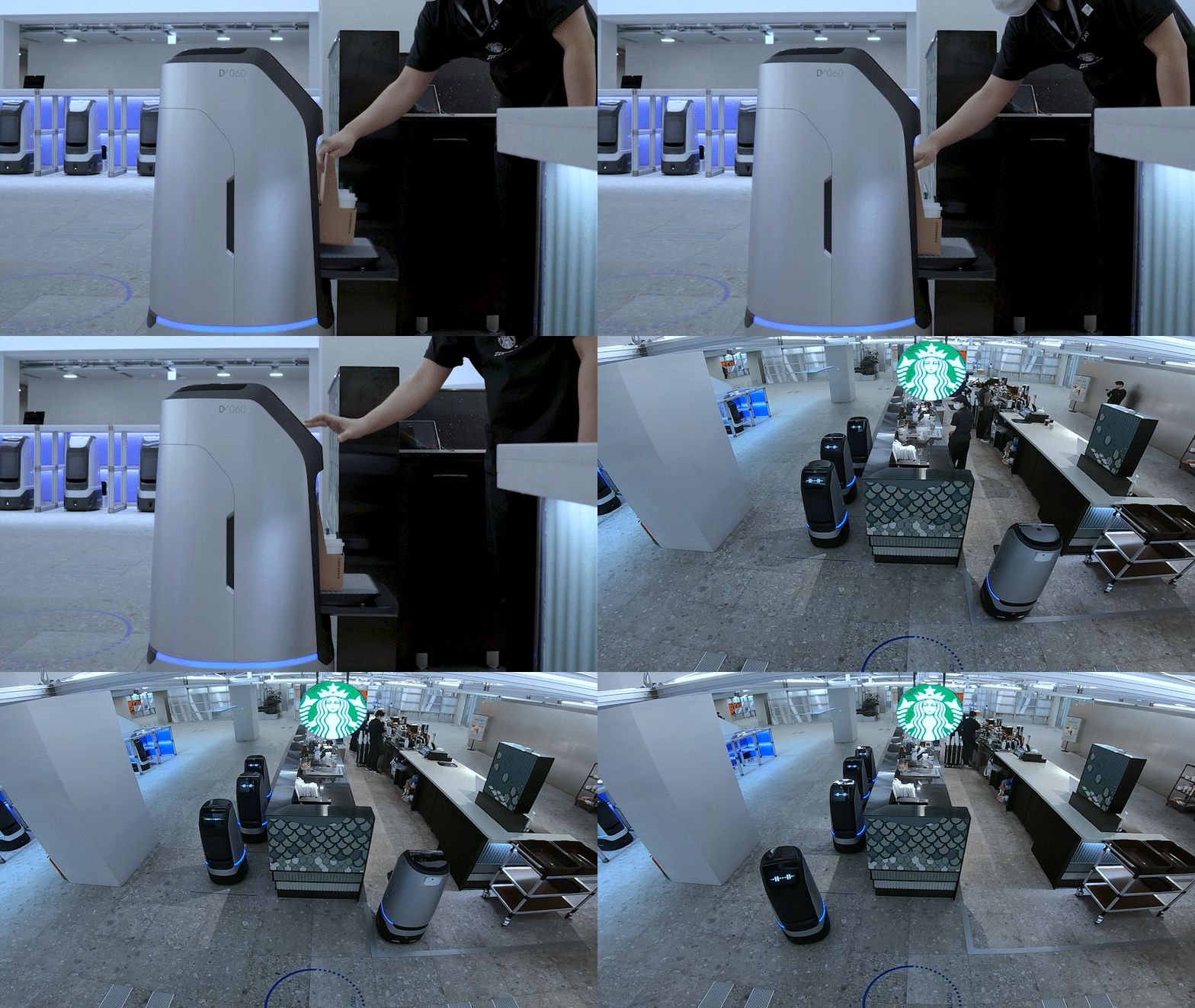
1784, NAVER's second headquarters, is the world's first robot-friendly building. It's also the largest testbed where robots seamlessly coexist with humans in everyday life. Here, over a hundred robots perform various everyday tasks, showcasing technological advancements in navigating the complex environments of a high-rise building.
How do 1784’s robots differ from conventional service robots or systems?
Multi-Robot: The Cloud as Their Brain
There is an enormous number of robots at 1784: more than one hundred. However, instead of independently performing their individual tasks, the robots operate through seamless connection to the cloud-based system, ARC, which acts as their collective brain. Simple services offered by one or two robots within a limited space may not require ARC. However, it is essential for future smart buildings.
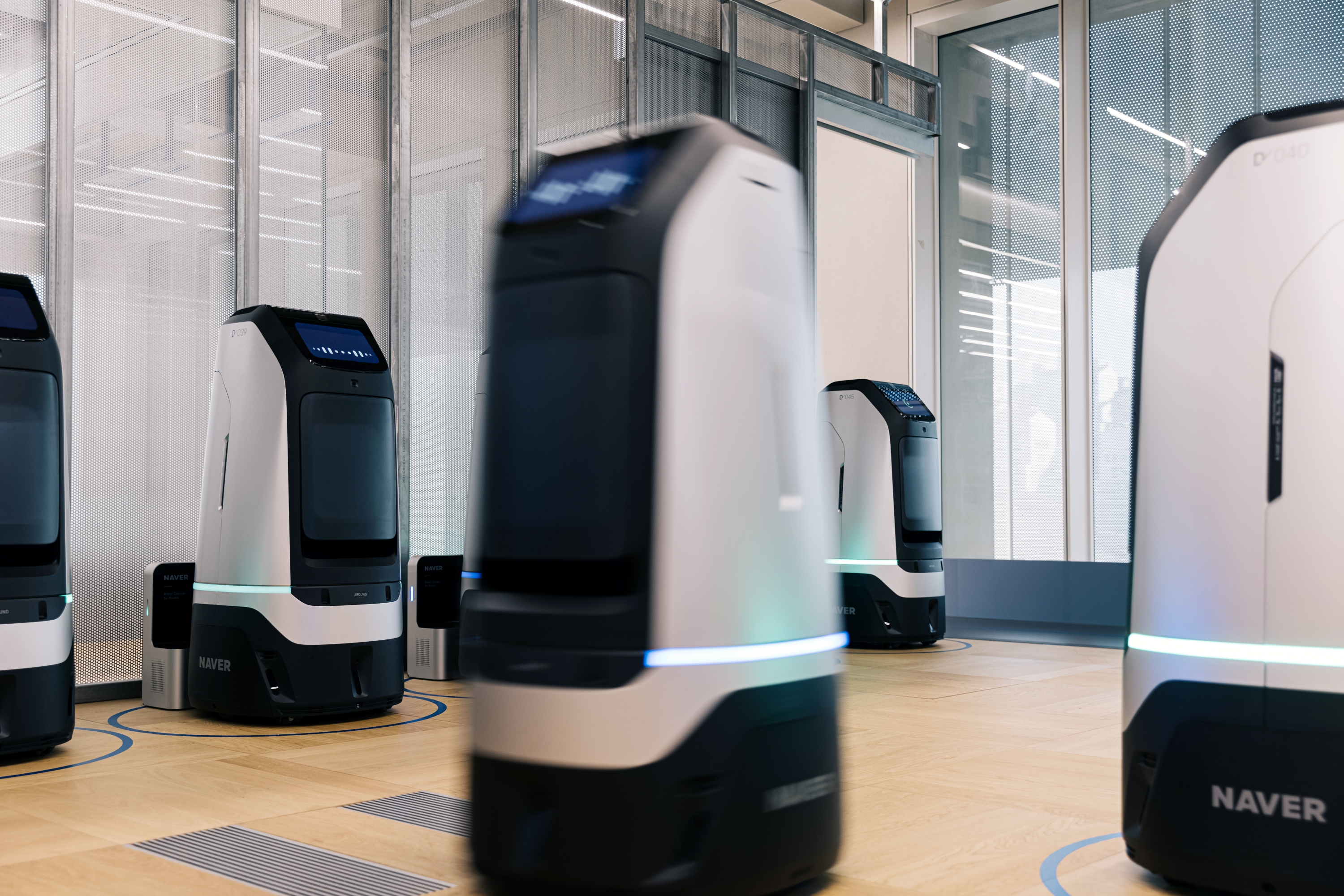
ARC contains the latest algorithms and high-precision data required by robots and is connected in real time to spatial infrastructure and various service systems. Instead of managing each robot separately, this system orchestrates and manages the entire robot network, enabling numerous robots to work faster and more efficiently.
Multi-Service: Unified Through a Single App
Since 2022, 1784 has continuously provided a variety of robot services. Robots here don't just blend into the background; they deliver Starbucks coffee, lunch boxes, convenience store orders, and even packages. Want to pass a simple document or item to a colleague? Let a robot handle it for you. The versatile service provider at 1784 is called Rookie.
It is remarkable to see how a single robot model, Rookie, can provide multiple services simultaneously in a building, considering that each service varies in scenarios, targets, routes, and peak times. Not to mention that each service requires integration with different systems. Thanks to its connection to ARC, Rookie can operate flexibly, focusing on coffee or package delivery during regular hours and shifting its focus to lunchbox delivery during lunch hours. Moreover, all these services are integrated into a single app, making robot services more accessible and convenient for people. Everything flows naturally.
Another ace up our sleeves is ARC mind. Developed by NAVER, ARC mind is the world’s first web platform-based OS dedicated to robots. Providing an environment where web developers can create various robot services, it paves the way for even more robot services to emerge.
Multi-Floor: Innovation in Vertical Movement
Enabling the efficient vertical movement of robots in high-rise buildings poses a significant challenge. It's not just about successfully getting a robot into an elevator; one also has to consider when people crowd in. Imagine peak hours, coming to/leaving from work and going for lunch. This is a challenge because robots need to move swiftly between floors to provide services. With this in mind, we developed the world's first robot-only elevator, ROBOPORT, in 1784.
ROBOPORT allows robots to move swiftly and safely using dedicated vertical rails. Ten carriers circulate on 128 m vertical rails that ascend and descend, with a horizontal movement device located in the the upper and lower rails. Technologies such as collision avoidance, predictive robot coordination, and pathfinding algorithms have been developed and implemented. Robots rapidly moving up and down call to mind the transportation systems of futuristic cities depicted in Sci-Fi novels.
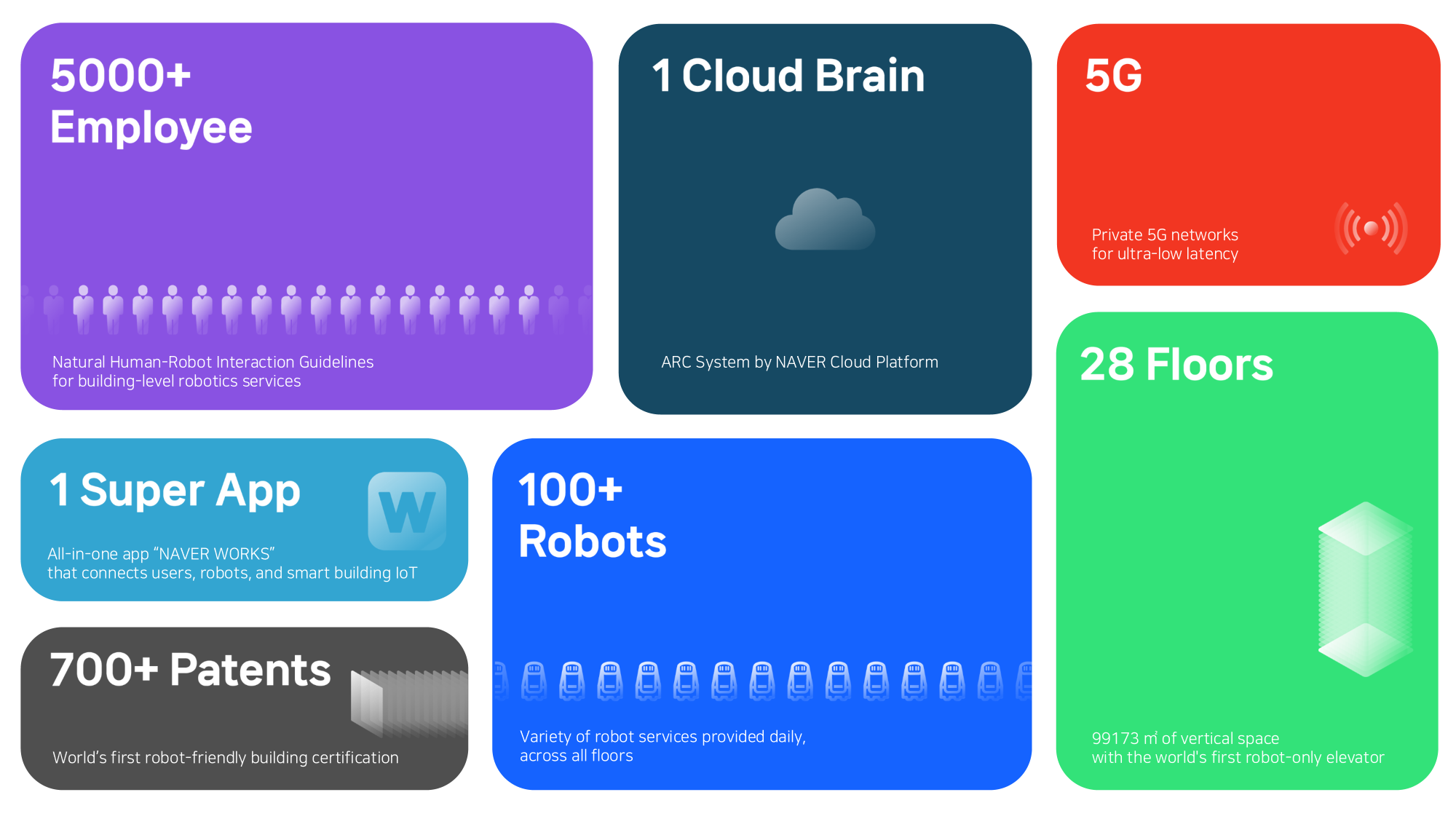
In NAVER 1784, where numerous robots coexist with people from the 8th basement level to the 28th floor, the technologies and infrastructures necessary to accommodate large-scale robots all come together. Beyond the advancement of robotics technologies, these innovations revolutionize how we live. 1784 will only become more and more exciting.